
Zambia · Motor claim preparation
Car insurance claims in Zambia
Get people to safety, notify the insurer promptly and obtain its instructions. Do not wait for a perfect document file before reporting the event.
Which claim are you preparing?
This organises questions for the insurer. It is not a national mandatory checklist or a claim submission.
Keep loss evidence and repair approval separate
- Policy/certificate and relevant payment evidence.
- Driver/licence and vehicle registration records requested.
- Factual account, safe photographs and police evidence where required.
- Requested estimates from accepted garages, assessment and written repair authority.
Madison’s published checklist includes three approved-garage quotations and inspection. Confirm your own insurer’s requirements; a garage estimate does not authorise work.
Report the theft and protect the document trail
- Ask the insurer and police which immediate reports apply.
- Record when the vehicle was last seen and the facts you know.
- Ask what keys, ownership, security or tracking evidence is needed.
- Retain reports and insurer instructions securely; do not publish identifying documents.
Do not infer theft cover from a liability-only certificate. Ask the insurer to assess the actual accepted theft section.
Pass the demand to the insurer promptly
- Keep correspondence, demand papers and the date received.
- Provide the incident account and requested driver/vehicle records.
- Ask who handles the response and what deadline applies.
- Keep injury, death and property evidence requirements distinct.
Do not invent liability or admit a version of events to complete a form. If an official admission-of-guilt document has been issued, ask how it belongs in the claim file.
Report and get a reference
Record the actual notification and document deadlines.
Send the evidence requested
Use the insurer’s verified secure route.
Wait for the relevant authority
A claim reference is not cover acceptance or repair approval.
How soon must you report an accident or theft?
Use the claim contact in your accepted policy or an independently checked official insurer channel. Explain the event and ask for a claim reference, immediate protection/towing instructions, the applicable notice deadline and the documents required for this claim type.
Do not adopt another insurer’s deadline. ZSIC General’s FAQ describes a particular notification and document process; it is an issuer example, not a universal reporting rule for every Zambian motor policy. Theft, collision, glass and third-party injury can also require different evidence and action.
For example, Goldman’s published process asks for immediate insurer notification and police reporting within 24 hours for the specified events. ZSIC’s FAQ describes insurer notification within 14 days for its example process. Treat these as evidence that the clocks differ, not permission to wait. Ask your own insurer what applies and report any delay truthfully.
Take reasonable protective steps without arranging avoidable work that conflicts with claim instructions. Where emergency recovery is necessary, retain the reason, instructions, provider and receipts. An unknown tow operator’s assurance that “insurance will pay” is not insurer authorisation.
| Ask | Record privately |
|---|---|
| Has the event been registered? | Claim/reference number, date and contact route. |
| What must happen now? | Police, recovery, security and urgent evidence instructions. |
| What deadline applies? | The relevant notification and later document-submission requirements. |
| Who may inspect or repair? | Approved assessment/repair route and how approval is issued. |
Build one claim file, with the right evidence for the event
Ask for the insurer’s list rather than treating the following worksheet as a mandatory national form. ZSIC’s published example includes a claim form, police evidence, driving and vehicle records and repair quotations. Other insurers and claim types can differ.
| Evidence group | Possible documents | Purpose |
|---|---|---|
| Contract | Schedule, certificate, wording and relevant payment records. | Identify the policy, insured period and selected sections. |
| Vehicle and driver | Registration/ownership records and accepted driver/licence evidence. | Reconcile the insured risk with the incident. |
| Incident | Factual account, photographs, requested police report and witness records. | Establish the reported circumstances and damage. |
| Assessment | Requested quotations, assessor instructions and approval. | Identify accepted work and the payment/repair route. |
| Third-party demands | Correspondence and supporting papers received. | Allow the insurer to assess liability and respond appropriately. |
Send documents through the verified secure route. Keep copies and a transmission record. If an item is missing or delayed, notify the insurer and ask what alternative evidence or next step it accepts. Do not fabricate a document to make a file appear complete.
Keep a repair quotation separate from authorisation
A garage’s estimate describes proposed work and cost. An assessor’s inspection records an assessment. Neither should automatically be treated as permission to begin repairs or a promise that every line will be paid.
Ask who appoints the repairer, what work is authorised, whether parts and labour are specified, how additional damage is reported, and who pays the excess. Confirm any invoice, salvage and collection requirements before accepting the completed vehicle.
Illustrative repair change
A garage initially estimates K12,000 of repairs. After inspection it finds additional damage and proposes K5,000 more. That arithmetic produces K17,000 of proposed work, but it does not expand the insurer’s authorisation. The motorist should use the approval route for the additional work and retain the decision. These are invented amounts, not a repair tariff.
If the car cannot safely be driven, discuss recovery and storage promptly. Ask how continuing storage charges are handled and what movement is permitted. Keep the vehicle available for any requested inspection.
Track the written outcome and question the right issue
A claim reference confirms a report has been logged. The insurer still needs to assess coverage, facts, liability, value and conditions. Ask what remains outstanding, who is handling it and when an update can be expected.
When an offer or rejection arrives, reconcile the amount with the decision: accepted damage, excess, limits, deductions and any relevant valuation basis. Ask for the governing wording and a written explanation of a disputed item. A missing document and an excluded event require different responses.
- Keep a dated log of notifications and requested evidence.
- Obtain the assessment or settlement explanation.
- Raise a specific factual or contractual concern with the insurer.
- Use its formal complaint route if the issue remains unresolved.
- Check the Pensions and Insurance Authority’s applicable escalation process.
For your next renewal, use what the claim exposed: an unaffordable excess, inadequate liability limit or transport gap may change your choice of motor cover. AfriPolicyCover does not receive claim evidence or submit instructions to the insurer.
Protect people first, then preserve a factual record
At an accident, prioritise immediate safety and appropriate emergency assistance. Do not stand in traffic to obtain photographs or turn a dangerous location into a document exercise. Follow directions from the relevant emergency or law-enforcement personnel.
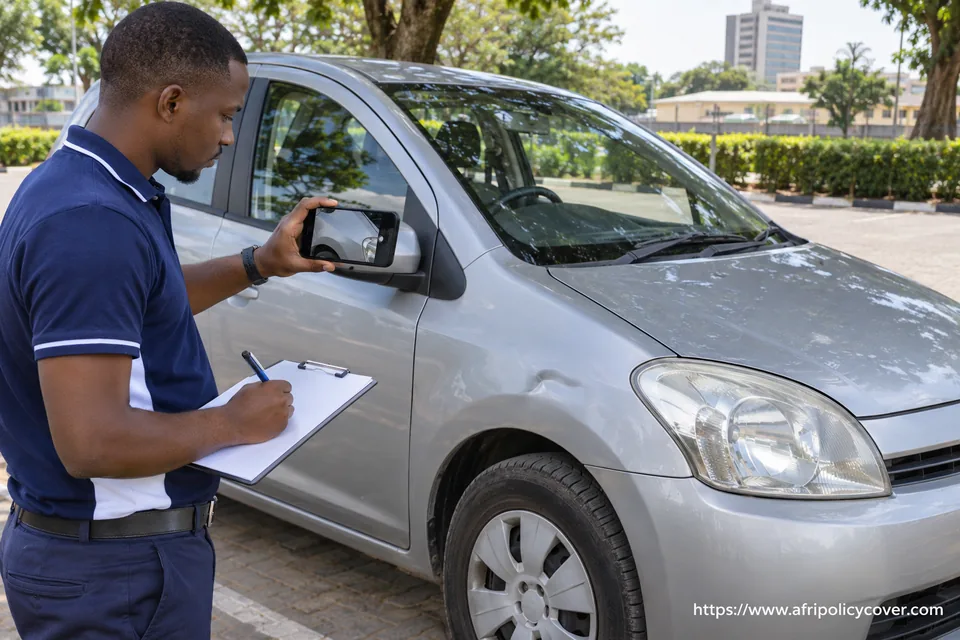
When safe, record the date, time, location, vehicles involved and what you directly observed. Photograph the vehicle positions and damage where feasible without exposing people to further risk. Keep witnesses’ details privately with their appropriate cooperation.
Separate observations from assumptions. You can describe a vehicle’s position or an impact without inventing a speed, accepting an unsupported version or changing who drove. If you later remember an important detail, add a dated factual note rather than rewriting the original account to look contemporaneous.
Questions while preparing a claim
How soon should I notify the insurer?
Notify promptly through your actual policy’s channel. The insurer and police can have different clocks; another company’s published deadline is not permission to wait.
Which documents are needed for a motor claim?
The event determines the list. Ask about the claim form, policy, driver/licence, vehicle, police and assessment records required for this case.
Must every claim have three garage quotations?
Some published insurer checklists, including Madison’s, request three approved-garage quotations. Confirm the current requirement and accepted garages with your own insurer.
Can I repair the car after receiving an estimate?
An estimate is not insurer authority. Get the required approval before arranging avoidable repairs; retain urgent protective instructions and evidence.
Does the claim reference mean it has been accepted?
No. Notification, document completeness, cover assessment and repair approval are separate stages.
How long will a motor insurance claim take?
Ask what remains outstanding and when the next decision or update is due. No universal settlement period is established here; keep the dated evidence and written responses.
What if the insurer rejects the claim?
Request the facts, calculation and policy clause relied on. Raise a specific complaint through the insurer, then check the applicable PIA escalation process.
Can I send claim documents through this page?
No. Use the insurer’s verified secure route. AfriPolicyCover does not receive certificates, police reports, identity documents or claim instructions here.
Sources and the terms to check
Provider links open company homepages. Exact research references are retained internally; a homepage does not establish your accepted price or policy terms. Examples labelled illustrative are calculations, not insurer quotations.
- ZSIC General company homepageInsurer-specific example of police evidence, claim form, vehicle/licence records and repair quotations; not a universal deadline or document list.
- Pensions and Insurance AuthorityRegulator starting point for insurer identity and unresolved complaint routing.
- Madison General company homepageInsurer-specific checklist distinguishes motor property claims and injury/death evidence, including approved quotations and inspection.
- Goldman company homepageIssuer-specific immediate insurer notice and police-report guidance; not a national deadline for every contract.
How AfriPolicyCover reviews information · Request a correction · Privacy information